Product














 Online Service


TrendForce: Server CPUs Face Supply Crunch, AMD Zen6 EPYC & Intel Nova Lake Preview
GPU has long been the focus of computing power discussions, but an overlooked shift is underway: CPUs are also in short supply.
For the first time, TrendForce has included CPUs in its weekly radar monitoring. The findings reveal a tight market: lead times have stretched from 16–20 weeks under balanced supply-demand conditions to 25–30 weeks, nearly doubling.
Why CPUs Are Tight in Supply
The direct driver of this supply crunch is the rise of agentic AI. As models begin to decompose tasks, invoke tools and orchestrate workflows on their own, the workload for task orchestration and logical scheduling surges, bringing CPUs back to center stage.
TrendForce’s latest report also notes that CPUs are merely the latest segment to see pressure. Lead times across the entire semiconductor supply chain are tightening:
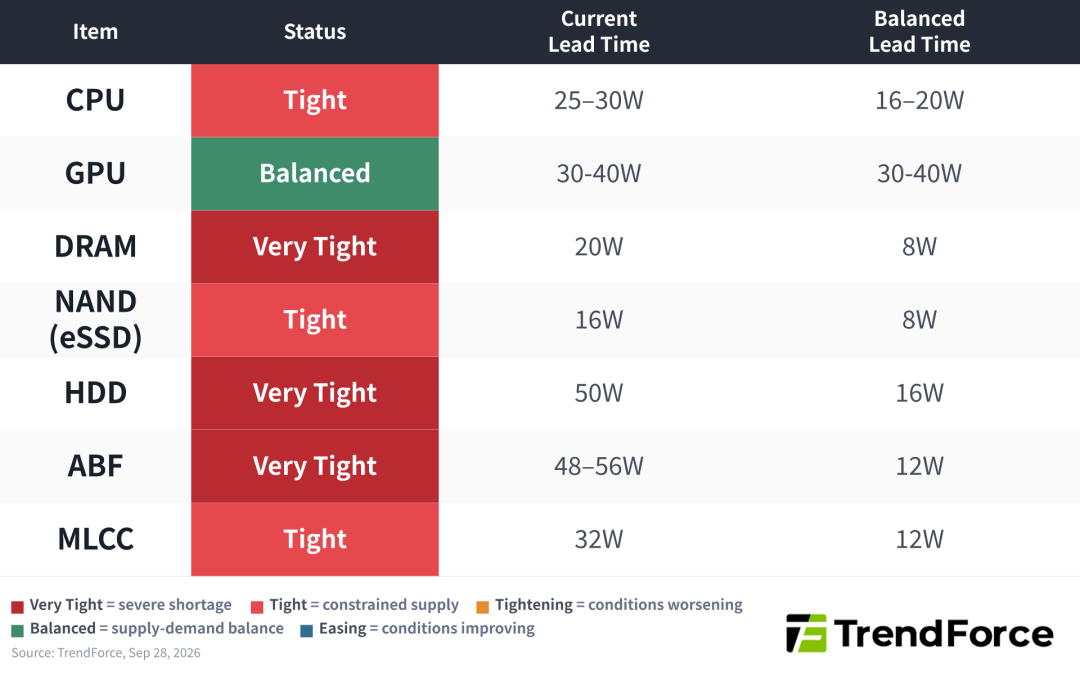
As shown in this chart, GPUs are the only segment remaining at market equilibrium, with lead times holding steady at 30–40 weeks, consistent with balanced conditions. In other words, GPUs, once the most sought-after component, have instead become the most "normal" link in the current cycle.
AMD: 256-Core Flagship at $14,904
Against tightening supply chains, new products continue to launch at a rapid pace. AMD has released full specifications and pricing for its EPYC 9006 series (codename Venice), built on the Zen 6 architecture. The platform debuted in July with partial performance previews.
The product lineup spans 8 to 256 cores, priced from $700 to $14,904 (approx. RMB 4,692–99,907).
In terms of product strategy, AMD splits the Venice family into two distinct platform camps.
The flagship SP7 platform prioritizes memory capacity and bandwidth: up to 16 memory channels, support for RDIMM and MDRDIMM, a maximum data rate of DDR5-12800, up to 96 PCIe 6.0 lanes, and a TDP range of 400W to 600W.
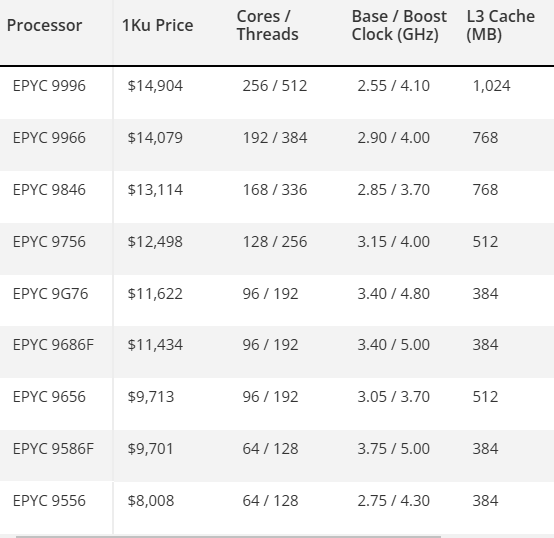
Consistent with typical server CPU economics, total cost rises with core count while per-core cost drops sharply: the flagship model costs only $58.21 per core (approx. RMB 390), while entry-level SKUs hit roughly $125.12 per core (approx. RMB 838), less than half of the entry price.
All SP7 SKUs support 1P/2P operation. A dual-node configuration with two 9996 CPUs delivers 512 Zen 6 cores at a processor-only cost of $29,808 (approx. RMB 199,814), not including steep memory expenses.
Intel: Certification Completed, Roadmap Confirmed
Intel’s next-generation Nova Lake has obtained USB-IF and PCI-SIG certifications. The mobile Nova Lake-H (Device IDs D331, D333) supports USB4 80Gbps, matching rumors around Thunderbolt 5; the desktop PCH-S chipset (6E6E) features USB 3.2 Gen2 (20Gbps), and no desktop processors supporting USB4 appear on the list.
The 900-series chipset has been listed with PCI-SIG since April. In early August, an undisclosed processor (D461, D465, D467-D46A) passed PCIe 5.0 x16 interoperability testing and is reasonably believed to belong to the Core Ultra 400 platform. Consolidated available information: up to 52 cores and 288MB bLLC cache. Launch is likely at CES in early January next year; 28-core models will ship first, with the 52-core flagship arriving two to three months later.
Taken together, demand focus is shifting from model training toward agentic AI deployment. The range of hardware under strain expands from GPUs to CPUs, memory, storage and carrier boards; suppliers respond to this shift with extended lead times.
For buyers and OEMs, this means two things: budgets must be planned well in advance, and sufficient lead-time buffers reserved. TrendForce’s decision to track CPUs also sends a signal: market attention is moving beyond individual hot components toward the collaborative capability of the full supply chain.
3DSTOR is a long-established global IT component supplier maintaining long-term stable partnerships with top-tier brands including Intel, AMD, NVIDIA, Western Digital and MSI. Its product portfolio covers servers, motherboards, graphics cards, CPUs, hard drives and more. Focused on serving global B2B markets, 3DSTOR delivers a wide range of AI / ML / HPC solutions and provides one-stop procurement services for IT hardware customers with diverse requirements.
 Previous page

.png)